
Who'd have thunk it?
Or, Sunlight is the best disinfectant, but don't let them minimise it.

Although David Seymour characterises it as a sideshow, one can’t help but think that the Police corruption crisis of the past few weeks must be the biggest story of the year. In terms of the concern it should generate among New Zealanders, it should be the biggest story of the decade were it not for Covid.
The discovery that the very top brass of the New Zealand Police force had engaged in a cover-up to protect a colleague who we now know was involved in serious criminal activity, as well as having an affair with a significantly younger person with whom there was a notable power imbalance, raises important questions that the Independent Police Conduct Authority has rightly examined. To his credit, the current Police Commissioner, Richard Chambers, has not tried to hide this issue. However, he has followed the typical NZ Police approach, suggesting that the corruption involved only a few bad apples within an otherwise hardworking group of officers.
This characterisation is somewhat undermined when, during the same period, over a hundred police officers are being investigated, though it appears only on an employment basis, for falsifying what seemed to be breath screening tests. We have also heard of three police officers, including a senior detective, who are being criminally investigated for offences similar to those of former Assistant Commissioner McSkimming, and potentially a lot more who are being investigated for ‘inappropriate material’ on their work devices. This is on top of one who recently pleaded guilty to, and two others who are standing trial next year on charges of attempting to pervert the course of justice by pointing out their suspect to the complainant before the photo montage where she… identified their suspect.
In a post on X at the beginning of this saga, I pointed out that defence lawyers who deal with the police on a daily basis have way more insight into police corruption than the average person:
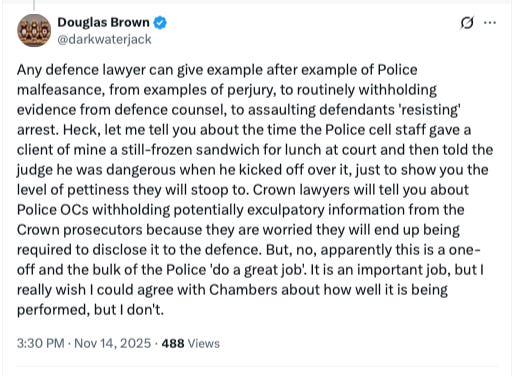
As with anything, it is only when the public becomes aware of a problem that action is taken. The reality is that the corruption at the top of the Police force did not occur in isolation. The officers involved in covering up an horrendous situation, disturbing on many levels, did not suddenly adopt this behaviour upon reaching their senior positions. Sadly, this is behaviour learned over many years in the police force and persists despite the Bazeley Report of 2007 and other subsequent inquiries.
New Zealand should hold its police force to high standards. It is a crucial role that must be carried out with honesty, integrity, and professionalism. Police officers should be the last to break the law, and we, the public, should be the last to condone their misconduct. Unfortunately, a culture within the Police tends to overlook such behaviour, and Parliamentary legislation, along with courts’ indulgence, gives officers a sense of invulnerability. The result is a shocking 130-page IPCA report that stunned the nation.
So, I plan to spend the next couple of posts discussing the IPCA report, my personal experiences, and some ideas for the future. I won’t go into too much detail since there’s already plenty out there, especially in the media, regarding the IPCA report, and it’s all available online if you want to read it. However, with my experience, I might be able to offer some insights you wouldn’t get elsewhere. I’ll try not to let my cynicism influence my views, but I can’t guarantee that. What I can promise is that my suggestions will be based on the idea that we need a police force that prioritises the country’s interests over its own.